
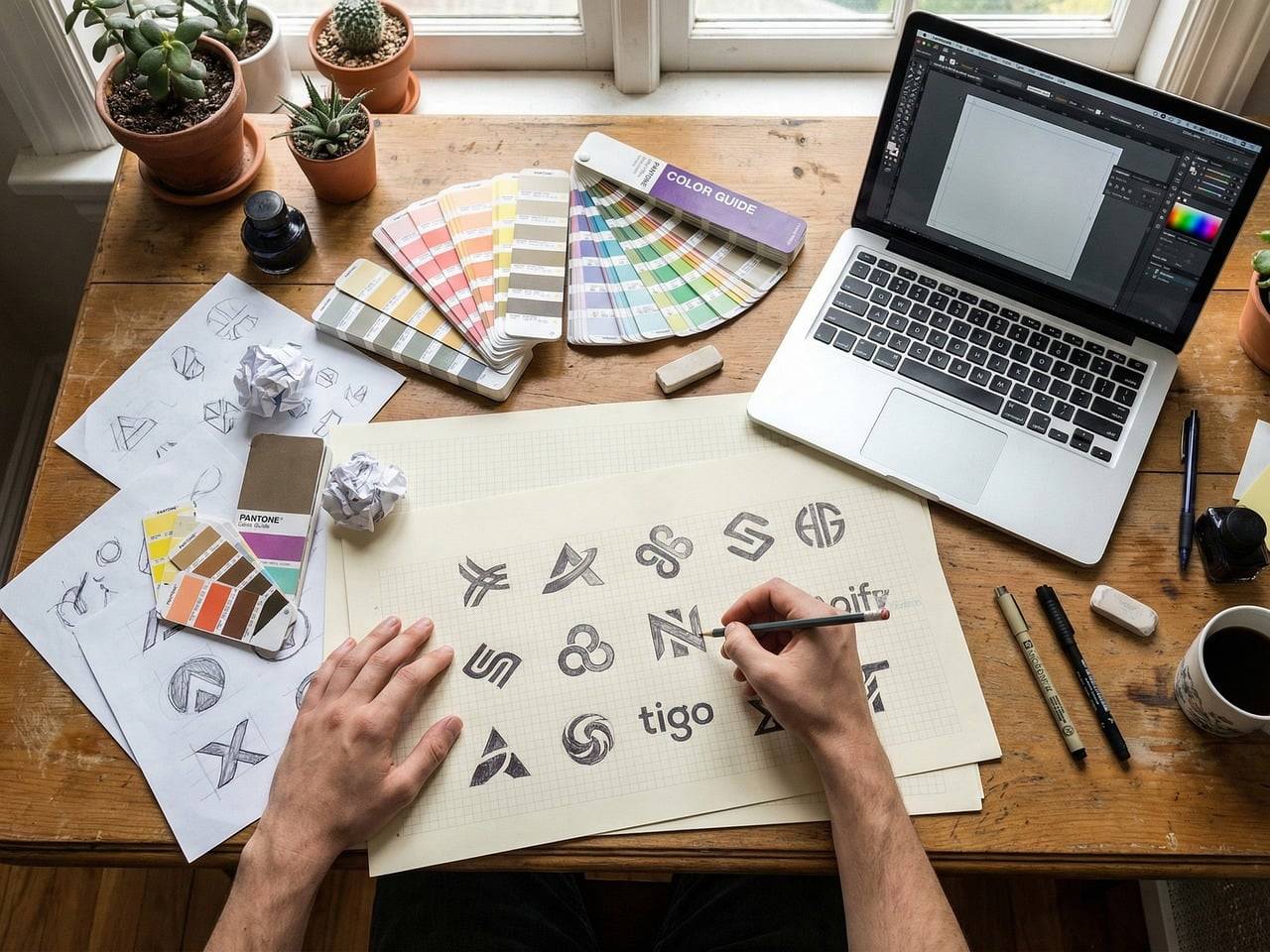
Staring at a blank page and wondering how to create a brand identity? Start with your audience and positioning, then add your name, voice, logo, colors and fonts, and record every choice in one guide.
This guide sits inside our wider coverage of branding design.
| Item | Value |
|---|---|
| Customers whose willingness to pay more is influenced by brand trust | 68% of customers |
| People who trust the brands they use | 80% of people |
| Customers who buy, choose or avoid brands over beliefs about society (Edelman, 2025) | 64% of customers |
| Store owners citing marketing as their biggest challenge (Shopify survey, 2025) | 37% of store owners |
| Store owners naming finding customers as their top struggle | 36% of store owners |
| Steps in Shopify’s brand-building process | 7 steps |
These figures come from Shopify’s brand-building guide, which cites Edelman and its own survey. Figures can change, so check the source before you rely on them.
What a brand identity includes and why it matters
A brand identity is the collection of elements a company creates to portray the right image to its consumers, as Superside’s guide puts it. Shopify makes a related point: building a brand goes beyond designing a logo or color palette.
GoDaddy lists the many components that make up a business personality. In practice, you will be making decisions in these areas:
- Your name and logo
- Your visual system, including colors, type and imagery
- Your positioning and messaging
- Your brand experience, advertising and tagline
The payoff is practical. Shopify’s guide reports that brand trust influences 68% of customers to pay more for products, and it cites Edelman’s 2025 data showing 64% of customers buy, choose or avoid brands based on their beliefs about society (source). Superside adds that a strong identity can command a price premium (source).
A practical order for the work
Shopify’s guide breaks brand building into 7 steps, and the same sequence suits identity work from scratch (source):
- Research your target market.
- Determine your brand’s voice and personality.
- Choose your business name.
- Write your brand story.
- Create your brand kit and style guide.
- Design your logo.
- Apply and grow your brand.
You will probably revisit some steps as awareness grows, so treat this as a starting order and not a rulebook. Notice that the logo comes late, after the thinking that tells you what it should express.
Research and position before you design
Good identity work starts with people, not pixels. The more clearly you understand who you are speaking to, the easier it is to build a brand that connects with them, Shopify notes. Here is how that research can look:
- Talk to people in your target market and ask which brands they buy from in your industry.
- Search your product or service category and study the direct and indirect competitors that appear.
- Visit competitors’ social accounts and websites to see who they talk to and what makes their product different.
If you already have a brand
A brand audit analyzes your current market perception, your competitors and your audience’s expectations, according to Superside. If you are updating an existing brand rather than starting fresh, the rebranding checklist covers that case in more detail.
Write the positioning
A brand positioning statement describes how you stack up against competitors (Shopify). Your unique value proposition is what sets you apart from those competitors (Superside). Write both in plain language before you open a design tool.
Choose your name, voice and story
Shopify counts your business name as part of identity, together with visual elements like your logo colors and the look of your photography and social media (source). Choose a name that fits the positioning you just wrote.
Brand voice is the tone your brand conveys. If customers expect a cheeky, frank tone from you on social media, the same guide advises carrying that through to your website copy and other communications (source).
Your mission guides business decisions, and your values are what your brand stands for, per the same source. Once those are settled, write a short brand story so your name, voice and values tell one consistent tale.
Design the logo, colors and type
Visuals come after strategy, so each choice has a reason behind it. Superside offers these pointers for your creative elements:
- Logo: keep it simple, memorable and representative of your brand.
- Colors: choose colors that reflect your brand’s personality and make it stand out.
- Typography: pick a primary font for headlines and a secondary font for body text.
- Imagery: keep photos, illustrations or icons in one consistent style that aligns with your brand.
GoDaddy notes that a visual system and color palette may convey a warm, friendly, approachable brand, while messaging carries a professional or humorous tone (source). For every logo, Shopify’s guidelines article suggests documenting the logo fonts and the rules for resizing, clearspace and color options.
Document it and roll it out
Brand guidelines are rules a business creates to standardize how it presents itself to the public (Shopify). Our full brand style guide walkthrough shows how to turn your choices into a document your whole team can follow.
A comprehensive guide goes into detail on a handful of core elements:
- Logos and typography
- Color palette and imagery
- Audience, voice and tone
- Grammar and style conventions
Timing matters. Shopify’s source recommends finalizing guidelines before designing your website to make the process smoother, and notes that they help new employees align with your identity (source).
Consistency is the goal. A consistent identity across all touchpoints lets customers recognize you and understand what you offer (GoDaddy). That matters because 37% of surveyed store owners cited marketing as their biggest challenge and 36% said finding customers was their top struggle in Shopify’s 2025 survey, and Shopify says learning to build a brand can help address both.
Frequently asked questions
What is the difference between a brand identity and brand guidelines?
Show answer
The identity is the set of decisions about how your brand should look and sound. The guidelines are the written rulebook that records those decisions so other people apply them correctly.
Where should you start if you have no brand at all?
Show answer
Begin by speaking with likely buyers and noting which names they already trust in your category. Those conversations feed your positioning, and positioning shapes every later design decision.
Should you design the logo first?
Show answer
Usually not. The logo is only one visual element, and it works better once your audience, positioning and voice are clear. In Shopify’s sequence, it follows the strategic work.
When do you need brand guidelines?
Show answer
As soon as anyone besides you touches the brand, such as a freelancer, an agency or a new hire. According to Shopify, such guidelines keep everyone on the same page.